↓
 

Miami Land Surveying

Local Land Surveyors in Miami, FL

Miami Florida Land Surveying
(305) 376-7707
Miami Land Surveying
  • Home
  • ALTA Survey
  • Boundary Surveying
  • Construction Survey
  • Drone LiDAR Mapping
  • Elevation Certificate
  • Land Surveying
  • Topographic Survey
  • About Us
  • Blog
  • Contact Us
Home→Author MiamiLS 1 2 3 … 10 11 >>

Author Archives: MiamiLS

Post navigation

← Older posts

What a Licensed Land Surveyor Can Legally Sign and Certify

Miami Land Surveying Posted on June 5, 2026 by MiamiLSJune 4, 2026
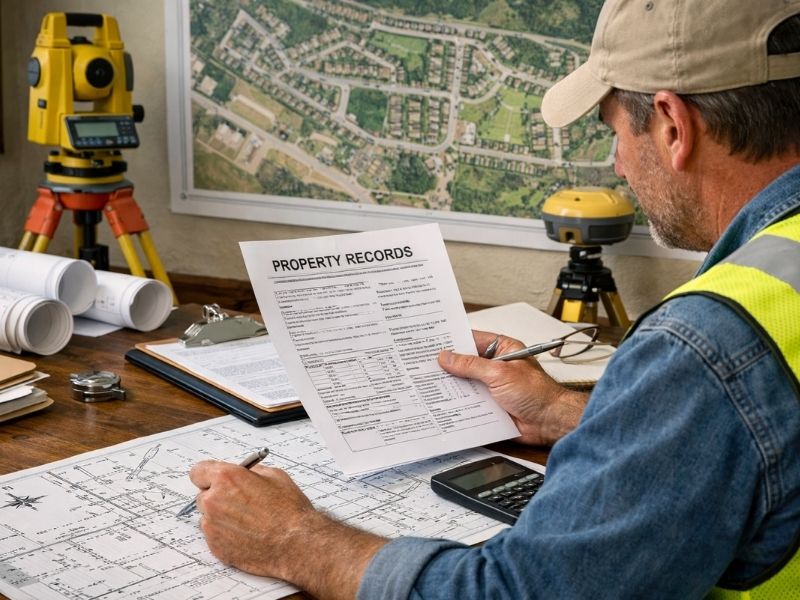
Licensed land surveyor reviewing property records and certified survey plans for boundary verification

Most developers know they need a survey before closing. Fewer know exactly what that survey must include to actually hold up legally. A licensed land surveyor can sign and certify specific documents, and only those documents carry legal weight for permits, lenders and title companies. Anything outside that scope is not a survey. It’s just a map.

What Makes a Land Surveyor Licensed

A land surveyor must hold an active Professional Surveyor and Mapper (PSM) license issued under Chapter 472 of the Florida Statutes. The Florida Department of Business and Professional Regulation (DBPR) issues and tracks these licenses.

Getting a PSM license requires:

  • A degree in surveying and mapping from an accredited program
  • Several years of supervised field experience
  • Passing the Fundamentals of Surveying exam
  • Passing the Principles and Practice of Surveying exam

You can verify any surveyor’s license status for free through the DBPR online database. The license number must also appear on every certified document the surveyor produces. If it’s not there, the document is not legally valid.

What a Licensed Land Surveyor Can Legally Sign

Boundary Survey

A licensed land surveyor can sign and certify a boundary survey. This is the document that shows the exact legal limits of a parcel. It reflects deed research, physical monument locations and field measurements.

A certified boundary survey is the only document a title company will accept to remove boundary-related exceptions from a title policy. It’s also what most building departments require before issuing a permit for new construction or additions.

Elevation Certificate

A licensed land surveyor can sign and certify a FEMA Elevation Certificate. This document records the elevation of a structure relative to the Base Flood Elevation (BFE) on the FEMA Flood Insurance Rate Map.

Lenders require it on properties in Special Flood Hazard Areas. Insurance companies use it to set flood insurance premiums. Without a PSM signature, FEMA does not recognize it as valid.

ALTA/NSPS Land Title Survey

A licensed land surveyor can sign and certify an ALTA/NSPS Land Title Survey. This is the survey type commercial lenders and title companies require on income-producing properties and larger transactions.

It follows a national standard set jointly by the American Land Title Association (ALTA) and the National Society of Professional Surveyors (NSPS). The surveyor must certify that the survey meets those standards on the face of the document. No PSM signature means no valid ALTA survey.

Subdivision Plat

A licensed land surveyor must sign and seal every subdivision plat before it can be recorded with the county. Florida Statutes Chapter 177 requires this. The plat creates the legal lots, streets and easements that form a subdivision. A county will not record a plat without a PSM seal.

Topographic Survey

A licensed land surveyor can sign and certify a topographic survey. This document maps the elevation and physical features of a site. Engineers and architects use it for grading, drainage and site design.

Construction Survey Documents

A licensed land surveyor can certify construction staking records and as-built surveys. These confirm that structures were placed where the approved plans required.

What a Licensed Land Surveyor Cannot Do

This matters as much as what they can do.

A PSM license does not authorize a surveyor to:

  • Give a legal opinion on title or ownership
  • Appraise land value
  • Practice civil engineering without a separate PE license
  • Provide legal advice on deed disputes or boundary litigation
  • Issue zoning opinions or land use determinations

If a boundary dispute ends up in court, the surveyor can testify about measurements and deed interpretation. They cannot act as the property owner’s attorney. The two roles don’t overlap.

Some surveyors also hold a Professional Engineer (PE) license. When that’s the case, they can certify engineering documents under that separate license. But the PSM license alone doesn’t cover it.

Why the Signature Matters to Developers

Permits Won’t Move Without It

Most local building departments require a survey signed and sealed by a licensed PSM before they’ll issue a permit. A sketch, a GIS printout or an unsigned drawing doesn’t satisfy that requirement. The permit application stalls until a certified survey is submitted.

Lenders Check the Seal

Commercial lenders review the surveyor’s license number and certification language before approving a construction loan. If the survey comes from an unlicensed provider, the lender’s underwriting team will reject it. That stops the loan.

Title Companies Rely on the Certification

When a title company issues a policy without boundary exceptions, they’re relying on the surveyor’s professional certification. The surveyor is legally responsible for the accuracy of the document. That’s what gives the certification its weight. An uncertified document gives the title company nothing to stand on.

How to Confirm a Surveyor’s License Before You Hire

Three steps. Takes five minutes.

  1. Ask the surveyor for their PSM license number before signing anything.
  2. Go to the Florida DBPR website and search the license database by name or number.
  3. Confirm the license is active and has no disciplinary history.

If the license is expired, suspended or shows a recent complaint, stop the conversation. Hire someone else. A survey signed by a lapsed PSM has no legal standing and will be rejected by permits, lenders and title companies.

Frequently Asked Questions

What does a licensed land surveyor legally certify?

A licensed Professional Surveyor and Mapper (PSM) can legally certify boundary surveys, elevation certificates, ALTA/NSPS land title surveys, subdivision plats, topographic surveys and construction survey documents. Each certified document carries the surveyor’s license number and professional seal, which gives it legal standing for permits, title insurance and lender review.

Can a licensed land surveyor give a legal opinion on a boundary dispute?

No. A PSM can testify about measurements, deed calls and survey findings, but they can’t provide legal advice or title opinions. That falls under the practice of law. If a boundary dispute escalates, you need a real estate attorney alongside the surveyor’s certified documentation.

What happens if a survey isn’t signed by a licensed surveyor?

It has no legal standing. The building department won’t accept it for a permit. A lender won’t accept it for a loan. A title company won’t use it to remove exceptions from a policy. The document is effectively useless for any official purpose.

Does a PSM license cover engineering work?

No. A PSM license covers surveying and mapping only. A surveyor who also holds a Professional Engineer (PE) license can certify engineering documents, but only under that separate PE license. The two licenses cover different scopes of work and can’t be substituted for each other.

How do I verify a land surveyor’s license is active?

Search the Florida Department of Business and Professional Regulation (DBPR) online license database. You can search by the surveyor’s name or license number. The result shows whether the license is active, expired or has any disciplinary actions on record. Always check before hiring.
Posted in land surveying | Tagged land survey, land surveying miami, land surveyor, licensed land surveyor

Why Boundary Survey Costs More Than Most Homeowners Expect

Miami Land Surveying Posted on June 4, 2026 by MiamiLSJune 2, 2026
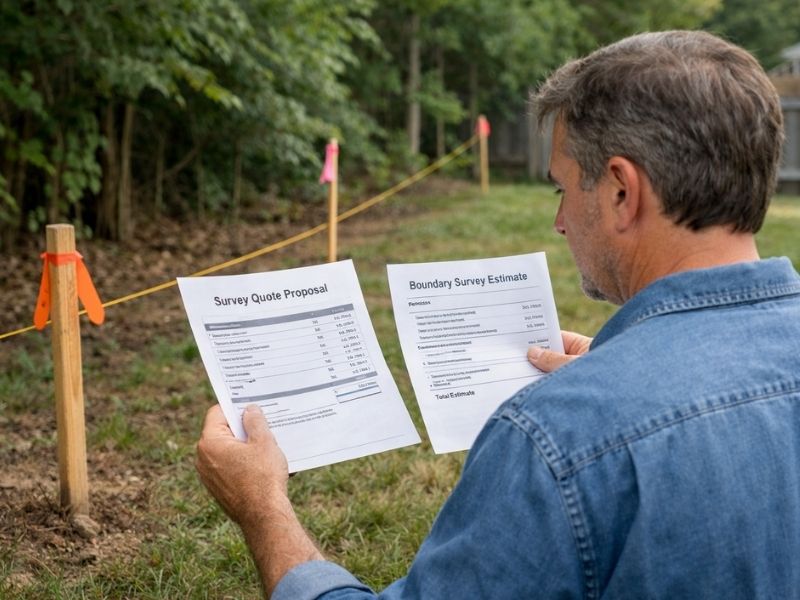
Homeowner reviewing a boundary survey cost estimate beside marked property lines and survey stakes

You call a surveyor, expect a simple quote, and the number comes back higher than you planned for. That happens a lot. Boundary survey cost isn’t based on how big your house is or how long the job takes in the field. It’s based on how much research, documentation and legal precision the job requires before anyone sets foot on your property. Once you understand what goes into it, the price makes sense

What You’re Actually Paying For

Most people think a boundary survey is just someone walking around with equipment and marking corners. That’s the last hour of the job.

The bulk of the work happens before the crew arrives. A licensed surveyor has to research your deed, pull prior survey records, check county plat maps and trace the chain of title. For older properties, that process alone can take days.

After the field work, the data has to be processed, checked and compiled into a certified legal document. The surveyor signs and seals it. That signature carries professional liability. If the survey is wrong, the surveyor is on the hook.

You’re not paying for stakes in the ground. You’re paying for legal accuracy and the professional responsibility behind it.

The Factors That Push Boundary Survey Cost Up

Lot Size and Shape

Larger lots take longer to survey. That part is obvious. What’s less obvious is that irregular lot shapes add more complexity than size alone. A standard rectangular lot with four corners is fast to close. An oddly shaped parcel with six or eight corners, curved boundaries or angular lines takes considerably longer to measure and verify.

Waterfront parcels are a separate category. When a boundary follows a natural feature like a shoreline or canal, the legal line doesn’t always match what you can see. That requires extra research and field verification.

Age of the Property Records

Older properties often have thin or inconsistent records. Deeds written decades ago used vague language. Plat maps from early subdivisions were drawn by hand and don’t always match what’s on the ground today.

When records are unclear, the surveyor has to do more work to establish what the legal boundary actually is. That means more title research, more time reviewing conflicting documents and sometimes consultation with neighboring property owners or their surveyors.

New construction in well-documented subdivisions costs less to survey. A 1940s bungalow with a metes and bounds deed in a neighborhood that’s been subdivided three times since then costs more.

Missing or Disturbed Monuments

When a surveyor locates your property corners, they look for existing physical monuments, which are iron pins, concrete markers or survey stakes set by a previous surveyor. If those monuments are missing, moved or destroyed, new ones have to be set.

Setting monuments requires extra field time. It also requires the surveyor to calculate positions from scratch using surrounding evidence. Neighbors’ fences, adjacent survey records and deed calls all factor in. This adds hours to the job.

Dense Vegetation and Difficult Terrain

A crew working a clear, flat lot moves fast. A crew working through overgrown brush, standing water or sloped terrain moves slowly. Line-of-sight is the foundation of survey measurements. When vegetation blocks it, crews spend time clearing or working around it.

Properties with heavy vegetation, canal frontage or irregular drainage features cost more to survey than a clean suburban lot on dry ground.

Urgency

Rush jobs cost more. If you need a certified survey in 48 hours for a closing that moved up, expect to pay a premium. Most surveys take one to three weeks under normal conditions. Compressing that timeline means pulling a crew off other work and accelerating the office processing. That has a price.

Why Urban Markets Cost More Than Rural Areas

Boundary survey cost in dense urban markets typically runs higher than rural or suburban areas. A few reasons drive that gap.

Dense urban development means more existing improvements to document. Easements are more common and more varied in older subdivisions. County permit records are more layered and complex. On top of that, demand in high-volume markets is consistently strong, and surveyors price accordingly.

A standard residential boundary survey typically falls between $500 and $2,000 for most lots. Larger, irregular or waterfront parcels go higher.

What Doesn’t Affect the Price (But People Assume It Does)

The value of your property has no effect on survey cost. A $2 million lot and a $300,000 lot of the same size and shape cost roughly the same to survey.

How long you’ve owned the property doesn’t matter either. A property you bought last year with a recent survey on file may actually cost less to resurvey than a property with a 30-year-old survey and missing monuments.

How to Get an Accurate Quote

Don’t accept a quote based on square footage alone. A good surveyor asks specific questions before pricing the job. They’ll want to know:

  • The legal description from your deed
  • Whether an existing survey is on file and how old it is
  • The type of survey needed (boundary, ALTA, elevation certificate)
  • The intended use (permit, closing, dispute resolution)
  • Your timeline

If a quote comes back without any of those questions being asked, it’s probably not accurate. You’ll either get an inflated number or a low quote that climbs once the surveyor sees the actual records.

Get at least two quotes. Ask both surveyors to break down what’s included. Compare scope, not just price.

Frequently Asked Questions

Why does boundary survey cost vary so much between properties?

Cost varies because each property has different research requirements, field conditions and record complexity. A newer home in a documented subdivision with intact monuments takes less time to survey than an older parcel with a metes and bounds deed, missing corners and unclear prior records. Lot size, shape, vegetation and terrain all factor in as well.

Does a higher property value mean a higher survey cost?

No. Survey cost is based on the work required, not the value of the land. Two properties of the same size and complexity cost roughly the same to survey regardless of market price. Location affects cost through labor rates and regional demand, but appraised value doesn’t.

What is included in a standard boundary survey?

A standard boundary survey includes title and deed research, location of existing monuments, field measurement of all boundary lines, comparison of measurements against the recorded legal survey, setting of new monuments where old ones are missing and a certified survey drawing signed and sealed by a licensed Professional Surveyor and Mapper.

Can I use an old survey instead of getting a new one?

Sometimes. Lenders and title companies set their own requirements, and many will not accept a survey older than one to five years. If monuments have moved, if adjacent parcels have changed or if the property has been modified since the last survey, a new one is required. Always confirm with your lender and title company before assuming an existing survey is acceptable.

What makes a waterfront property cost more to survey?

Waterfront and canal properties often have boundaries that follow natural features like shorelines or mean high-water lines. Those legal boundaries require extra field verification and may not match visible physical features. Easements and riparian rights add another layer of research. Combined, these factors increase both field time and office processing time.

Posted in land surveying | Tagged boundary survey, boundary survey cost, boundary survey miami

How a Metes and Bounds Survey Affects Your Deed

Miami Land Surveying Posted on June 3, 2026 by MiamiLSJune 2, 2026
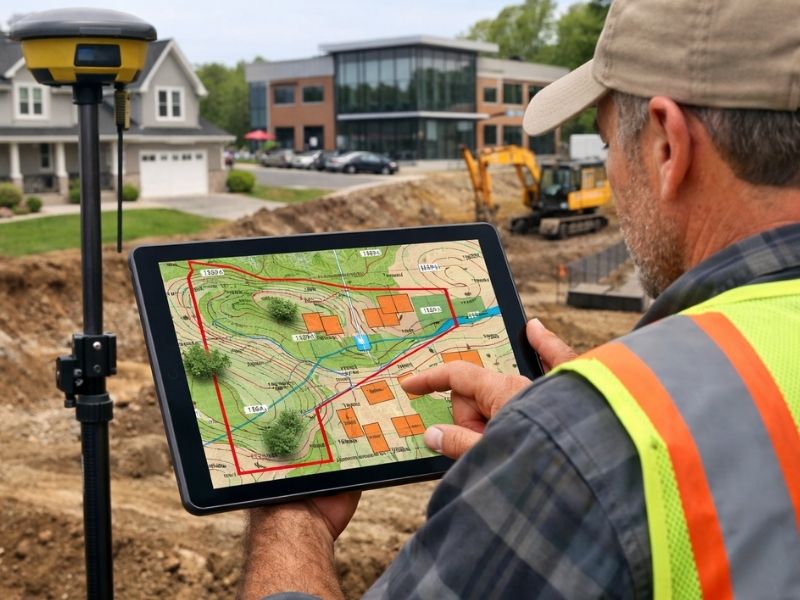
Land surveying professional reviewing a property boundary map and legal land survey data on a construction site

A metes and bounds is the legal language that defines exactly where your property begins and ends. If your deed uses this system, a surveyor reads those written directions and turns them into physical markers on the ground. Get it wrong, and your transaction stalls, your title has gaps, or your boundary ends up in the wrong place.

What Is a Metes and Bounds Survey?

It’s a way of describing land using directions and distances. Instead of saying “Lot 5, Block 3,” a metes and bounds survey walks the boundary line step by step.

It starts at a fixed point called the Point of Beginning (POB). From there, it gives a bearing (a compass direction) and a distance. Then another. Then another. Until it loops back to where it started.

A simple example looks like this:

“Beginning at the iron pin at the northeast corner of the tract, thence South 45 degrees West, 200 feet, thence North 45 degrees West, 150 feet, thence North 45 degrees East, 200 feet, thence South 45 degrees East, 150 feet to the Point of Beginning.”

That’s it. No lot number. No plat map reference. Just directions and distances.

Where This System Shows Up

Metes and bounds surveys are common on:

  • Older properties recorded before subdivision plats existed
  • Irregular-shaped lots that don’t fit a standard grid
  • Waterfront and coastal parcels where boundaries follow natural features
  • Large tracts and acreage that were never formally subdivided
  • Properties split off from larger parcels by private agreement

If your deed reads like a set of walking directions, you’re looking at metes and bounds.

How It Affects Your Deed

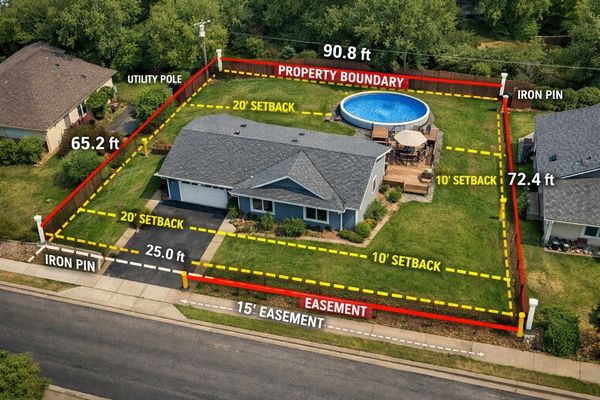
Land surveying illustration showing property boundaries, setbacks, easements, and boundary monuments on a residential lot

The Survey Is the Legal Boundary

In a metes and bounds deed, the written survey controls everything. Not the fence. Not the neighbor’s claim. Not what the previous owner told you.

If the survey says the line runs 200 feet south, then 200 feet south is the legal boundary, regardless of where the old fence sits.

A licensed surveyor takes that written language and locates it physically on the ground. They research the chain of title, find existing monuments, measure distances and check them against the recorded deed. What they produce is the legal map of your property.

Errors in the Survey Create Real Problems

Metes and bounds surveys can have mistakes. Common ones include:

  • A typo in a bearing (South 45 degrees instead of South 54 degrees changes the line entirely)
  • A distance that doesn’t match existing monuments in the field
  • A survey that “fails to close,” meaning the boundary doesn’t return to the Point of Beginning

When a survey fails to close, it means the math doesn’t work out. The boundary lines don’t form a complete shape. That’s a defect in the deed, and it creates a legal problem that has to be fixed before a clean title can be issued.

Conflicts Between Calls

A metes and bounds survey has different types of calls. Monument calls refer to a physical object (an iron pin, a concrete marker, a tree). Distance calls give a measurement. Bearing calls give a direction.

When these conflict, there’s a legal order of priority:

  1. Natural monuments (rivers, rock formations)
  2. Artificial monuments (iron pins, concrete markers)
  3. Adjacent boundaries (neighboring deed lines)
  4. Distances
  5. Bearings
  6. Area

So if the deed says “thence to the iron pin” but the distance listed doesn’t reach the iron pin, the iron pin wins. The distance is secondary. A surveyor knows this hierarchy. A buyer relying on a county GIS map does not.

Why Developers Need to Pay Attention

Due Diligence Before You Buy

Before acquiring a parcel described by metes and bounds, you need a boundary survey. Not a tax parcel map. Not a GIS overlay. A field-verified survey by a licensed Professional Surveyor and Mapper.

The survey will confirm:

  • The survey actually closes
  • The bearings and distances match what’s on the ground
  • There are no gaps or overlaps with neighboring parcels
  • Monuments exist and are in the right locations

If the surveyor finds a problem, you know before you close, not after.

Title Insurance Won’t Always Cover Survey Defects

Title companies look hard at metes and bounds surveys before issuing a policy. If a survey is defective or the boundary has a gap, the title company may exclude that portion from coverage. That means the defect stays your problem even after closing.

A boundary survey submitted before closing gives the title company what it needs to issue a clean policy, or to flag the problem early enough to fix it.

Easements and Encroachments Are Harder to Spot

On a platted lot, easements are usually shown on the recorded plat. On a metes and bounds parcel, they may only exist in the deed language or in separate recorded instruments. A surveyor researches those documents and shows them on the survey map.

Without that step, you can buy a parcel not knowing a utility easement cuts through the middle of your planned building footprint.

What Happens When a Survey Is Defective

If a metes and bounds survey has an error, the options are:

  • Corrective deed: The grantor (seller or prior owner) signs a new deed correcting the error. This is the cleanest fix.
  • Boundary line agreement: Neighboring property owners agree in writing where the line sits. Both sign. Both record it.
  • Quiet title action: A court proceeding that legally establishes ownership and boundary when other methods fail. This is slow and expensive.

None of these are quick. All of them are cheaper to avoid by catching the problem before closing.

Frequently Asked Questions

What is a metes and bounds survey?

A metes and bounds survey is a field measurement performed by a licensed surveyor to locate and verify the boundary described in a metes and bounds deed. The surveyor researches the title chain, finds existing monuments, measures distances and bearings, and produces a certified map showing the legal boundary on the ground.

How do I know if my deed uses metes and bounds?

Open your deed and look at the legal survey. If it lists compass bearings (like “North 30 degrees East”), distances in feet, and references a Point of Beginning, it’s a metes and bounds survey. If it says “Lot 4, Block 2 of [Subdivision Name],” it uses the lot-and-block system instead.

What does it mean when a metes and bounds survey fails to close?

It means the boundary lines, when plotted, don’t return to the Point of Beginning. The shape doesn’t close. This is a defect in the deed. It has to be corrected before a title company will issue a clean policy or before a lender will approve a loan on the property.

Can a boundary survey fix a bad metes and bounds survey?

A survey identifies the problem. It doesn’t fix it on its own. The fix usually requires a corrective deed, a boundary line agreement with neighboring owners, or a court action. The survey gives you and your attorney the accurate information needed to pursue the right remedy.

Do I need a new survey if the property already has one on file?

It depends on how old the survey is and what has changed since it was done. If monuments have moved, if neighboring parcels have been split or reconfigured, or if the survey is more than a few years old, a new survey is usually required by lenders and title companies before closing.

Posted in land surveying | Tagged boundary survey, Land Surveying, land surveyor miami

Post navigation

← Older posts
Get Quote Button

Select Your City

  • Aventura
  • Coral Gables
  • Cutler Bay
  • Doral
  • Hialeah
  • Homestead
  • Miami Beach
  • Miami Gardens
  • Miami Lakes
  • North Miami
  • North Miami Beach

The owner of this website, USA Surveying & Engineering, LLC., provides coordination of professional land surveying and engineering services in all 50 states. The professional surveying and engineering services provided to you will be conducted by fully licensed professionals in your state.

Privacy Policy | Terms of Use
↑