
How a Metes and Bounds Survey Affects Your Deed
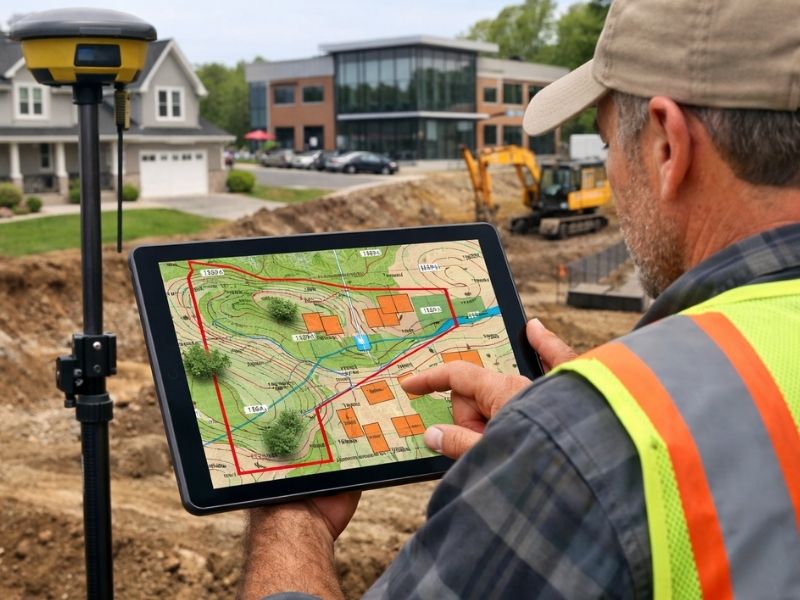
A metes and bounds is the legal language that defines exactly where your property begins and ends. If your deed uses this system, a surveyor reads those written directions and turns them into physical markers on the ground. Get it wrong, and your transaction stalls, your title has gaps, or your boundary ends up in the wrong place.
What Is a Metes and Bounds Survey?
It’s a way of describing land using directions and distances. Instead of saying “Lot 5, Block 3,” a metes and bounds survey walks the boundary line step by step.
It starts at a fixed point called the Point of Beginning (POB). From there, it gives a bearing (a compass direction) and a distance. Then another. Then another. Until it loops back to where it started.
A simple example looks like this:
“Beginning at the iron pin at the northeast corner of the tract, thence South 45 degrees West, 200 feet, thence North 45 degrees West, 150 feet, thence North 45 degrees East, 200 feet, thence South 45 degrees East, 150 feet to the Point of Beginning.”
That’s it. No lot number. No plat map reference. Just directions and distances.
Where This System Shows Up
Metes and bounds surveys are common on:
- Older properties recorded before subdivision plats existed
- Irregular-shaped lots that don’t fit a standard grid
- Waterfront and coastal parcels where boundaries follow natural features
- Large tracts and acreage that were never formally subdivided
- Properties split off from larger parcels by private agreement
If your deed reads like a set of walking directions, you’re looking at metes and bounds.
How It Affects Your Deed
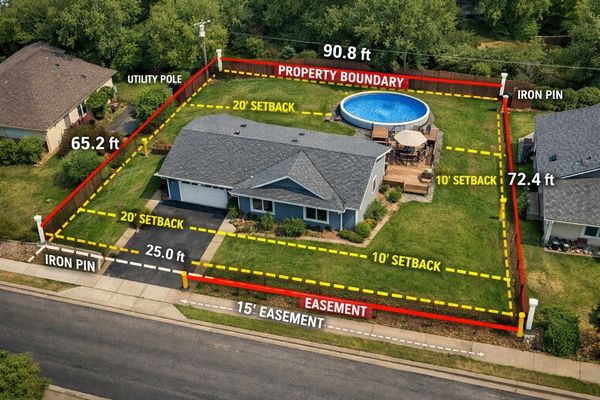
The Survey Is the Legal Boundary
In a metes and bounds deed, the written survey controls everything. Not the fence. Not the neighbor’s claim. Not what the previous owner told you.
If the survey says the line runs 200 feet south, then 200 feet south is the legal boundary, regardless of where the old fence sits.
A licensed surveyor takes that written language and locates it physically on the ground. They research the chain of title, find existing monuments, measure distances and check them against the recorded deed. What they produce is the legal map of your property.
Errors in the Survey Create Real Problems
Metes and bounds surveys can have mistakes. Common ones include:
- A typo in a bearing (South 45 degrees instead of South 54 degrees changes the line entirely)
- A distance that doesn’t match existing monuments in the field
- A survey that “fails to close,” meaning the boundary doesn’t return to the Point of Beginning
When a survey fails to close, it means the math doesn’t work out. The boundary lines don’t form a complete shape. That’s a defect in the deed, and it creates a legal problem that has to be fixed before a clean title can be issued.
Conflicts Between Calls
A metes and bounds survey has different types of calls. Monument calls refer to a physical object (an iron pin, a concrete marker, a tree). Distance calls give a measurement. Bearing calls give a direction.
When these conflict, there’s a legal order of priority:
- Natural monuments (rivers, rock formations)
- Artificial monuments (iron pins, concrete markers)
- Adjacent boundaries (neighboring deed lines)
- Distances
- Bearings
- Area
So if the deed says “thence to the iron pin” but the distance listed doesn’t reach the iron pin, the iron pin wins. The distance is secondary. A surveyor knows this hierarchy. A buyer relying on a county GIS map does not.
Why Developers Need to Pay Attention
Due Diligence Before You Buy
Before acquiring a parcel described by metes and bounds, you need a boundary survey. Not a tax parcel map. Not a GIS overlay. A field-verified survey by a licensed Professional Surveyor and Mapper.
The survey will confirm:
- The survey actually closes
- The bearings and distances match what’s on the ground
- There are no gaps or overlaps with neighboring parcels
- Monuments exist and are in the right locations
If the surveyor finds a problem, you know before you close, not after.
Title Insurance Won’t Always Cover Survey Defects
Title companies look hard at metes and bounds surveys before issuing a policy. If a survey is defective or the boundary has a gap, the title company may exclude that portion from coverage. That means the defect stays your problem even after closing.
A boundary survey submitted before closing gives the title company what it needs to issue a clean policy, or to flag the problem early enough to fix it.
Easements and Encroachments Are Harder to Spot
On a platted lot, easements are usually shown on the recorded plat. On a metes and bounds parcel, they may only exist in the deed language or in separate recorded instruments. A surveyor researches those documents and shows them on the survey map.
Without that step, you can buy a parcel not knowing a utility easement cuts through the middle of your planned building footprint.
What Happens When a Survey Is Defective
If a metes and bounds survey has an error, the options are:
- Corrective deed: The grantor (seller or prior owner) signs a new deed correcting the error. This is the cleanest fix.
- Boundary line agreement: Neighboring property owners agree in writing where the line sits. Both sign. Both record it.
- Quiet title action: A court proceeding that legally establishes ownership and boundary when other methods fail. This is slow and expensive.
None of these are quick. All of them are cheaper to avoid by catching the problem before closing.
Frequently Asked Questions
What is a metes and bounds survey?
A metes and bounds survey is a field measurement performed by a licensed surveyor to locate and verify the boundary described in a metes and bounds deed. The surveyor researches the title chain, finds existing monuments, measures distances and bearings, and produces a certified map showing the legal boundary on the ground.
How do I know if my deed uses metes and bounds?
Open your deed and look at the legal survey. If it lists compass bearings (like “North 30 degrees East”), distances in feet, and references a Point of Beginning, it’s a metes and bounds survey. If it says “Lot 4, Block 2 of [Subdivision Name],” it uses the lot-and-block system instead.
What does it mean when a metes and bounds survey fails to close?
It means the boundary lines, when plotted, don’t return to the Point of Beginning. The shape doesn’t close. This is a defect in the deed. It has to be corrected before a title company will issue a clean policy or before a lender will approve a loan on the property.
Can a boundary survey fix a bad metes and bounds survey?
A survey identifies the problem. It doesn’t fix it on its own. The fix usually requires a corrective deed, a boundary line agreement with neighboring owners, or a court action. The survey gives you and your attorney the accurate information needed to pursue the right remedy.
Do I need a new survey if the property already has one on file?
It depends on how old the survey is and what has changed since it was done. If monuments have moved, if neighboring parcels have been split or reconfigured, or if the survey is more than a few years old, a new survey is usually required by lenders and title companies before closing.
